
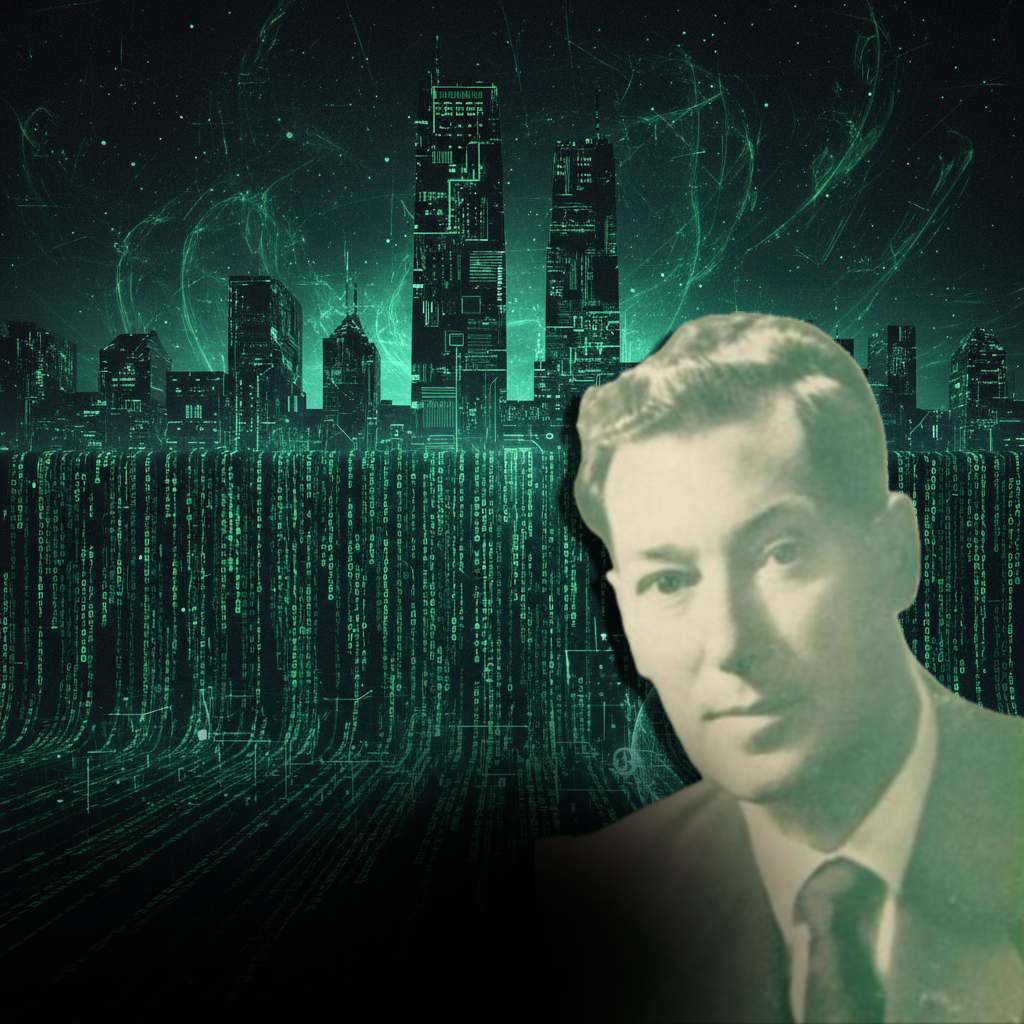
Neville Goddard: The Law of Assumption - Part 1: Biography and Foundations
Who was Neville Goddard? Explore his extraordinary life and the fundamental principles of the Law of Assumption that continue to inspire millions.
In the crowded landscape of spiritual teachers and manifestation coaches, few figures have had as profound and lasting an impact as Neville Lancelot Goddard. Born in the Caribbean and trained as a classical actor, Neville became one of the 20th century's most influential teachers on consciousness and manifestation. His central teaching, the Law of Assumption, is deceptively simple yet profoundly transformative: whatever you assume to be true becomes your experience of reality. It is not positive thinking, it is not wishing, but a deliberate and methodical practice of assuming your desires are already fulfilled.
Who Was Neville Goddard?
Understanding Neville requires understanding his unique background, a fusion of Caribbean mysticism, classical theater, and spiritual awakening.
The Early Years (1905-1927): A Mystical Beginning
Neville Lancelot Goddard was born on February 19, 1905, in St. Michael, Barbados, into a family described as respectable and spiritually aware. His father, Goddard Joseph, was a merchant, and his mother came from a Methodist background. Growing up in Barbados, Neville was exposed to spiritual ideas and metaphysical thought from an early age. At 17, in 1922, he moved to New York City to pursue his passion for acting and dance. He performed in Broadway productions and was a trained classical actor, a fact that would prove crucial to his understanding of visualization and imagination. However, acting was only the outer life; his inner life was being shaped by deeper spiritual questions about consciousness, reality, and human potential.
The Crucial Moment (1931): Abdullah and the Awakening
The transformative moment in Neville's life came in 1931 when he met an Ethiopian Jewish mystic named Abdullah. Abdullah became Neville's teacher and mentor, introducing him to the deeper principles of consciousness and imagination. Under Abdullah's guidance, Neville underwent a profound spiritual awakening. Abdullah taught him that imagination is God, that the Bible is not history but psychology, and that consciousness is the only reality. Above all, Abdullah introduced Neville to the concept that would become his life's work: the Law of Assumption. Abdullah would ask Neville challenging questions: 'What would it be like if you were already that?' This simple question became the seed of a revolutionary teaching. Neville later wrote that Abdullah told him: 'You can be anything you want to be if you assume you already are it.' These were not mere words; they were the keys to a science of consciousness.
The Teaching Years (1938-1972): Spreading the Law of Assumption
After his awakening, Neville spent more than three decades teaching the Law of Assumption to anyone who would listen. He lectured in cities across America, wrote numerous books, and recorded countless lectures. His works include 'Feeling is the Secret', 'The Power of Awareness', 'Awakened Imagination', 'The Law and the Promise', 'Resurrection', and many others. What set Neville apart from other teachers was his clarity, his practical approach, and his insistence on empirical verification. He did not ask people to believe him on faith; he asked them to test his teachings and prove them for themselves. Neville emphasized that it was not religion, not philosophy, but a science, a repeatable and verifiable method for transforming consciousness and reality. He taught that every person already possesses the power to reshape their life through the disciplined use of imagination. He passed away on October 1, 1972, but his teachings continue to influence modern manifestation teachers, from Wayne Dyer to Rhonda Byrne to contemporary spiritual coaches.
The Foundation: What is the Law of Assumption?
The Law of Assumption is Neville's most radical and powerful teaching. At its core, it is deceptively simple: whatever you habitually assume to be true becomes your lived experience.
The Central Principle
Neville taught that imagination is the creative power within us, the power of God. Your imagination is not fantasy or daydreaming; it is the activity through which reality is constructed. Most people believe that external circumstances determine their thoughts and feelings: 'I will be happy when I get the job, the relationship, the money.' Neville taught the reverse: your internal assumptions determine your external circumstances. You do not get what you want; you get what you assume you already are. This is the Law of Assumption. If you assume you are poor, deserving of poverty, and incapable of wealth, you will experience poverty. If you assume you are successful, deserving of abundance, and capable of achieving your goals, you will experience success. The assumption is the root; the manifestation is the fruit.
Imagination as a Creative Force
Central to Neville's teaching is the preeminence of imagination. In his seminal work 'Awakened Imagination', Neville distinguished three types of imagination: fantasy (idle daydreaming with no emotional involvement), memory (thought based on the past), and true imagination (the ability to conceive and assume a desired state as already true). True imagination, according to Neville, is God. When you imagine something vividly, with emotion and conviction, and assume it is already true, you set forces in motion that bring it to manifestation. Neville taught that imagination is not just a tool or a technique; it is the very power that creates reality. Your habitual imaginings become your world. Therefore, the most important practice is to control your imagination and deliberately imagine your desired reality as already accomplished.
The Power of Feeling and Assumption
Neville emphasized that assumption is not mere intellectual belief. It is a feeling, a genuine emotional conviction that something is already true. In 'Feeling is the Secret', Neville wrote that feeling is the secret to manifestation. An assumption without feeling is empty. You must feel as if your desire were already realized. If you assume you are wealthy but feel poor and anxious, the feeling of poverty dominates your consciousness and therefore your reality. But if you assume and feel wealth, feel the relief, joy, and security of abundance, then wealth becomes your lived experience. This is why Neville spent so much time teaching people how to deliberately cultivate the feeling of desires already fulfilled.
The Distinction: Assumption vs. Belief vs. Positive Thinking
To understand Neville's teaching, it is crucial to distinguish between related but different concepts that are often confused.
Assumption vs. Belief
Belief is intellectual acceptance. You can believe something is true without embodying it. Assumption, on the other hand, is taking something as true. When you assume, you are not hoping or trying to convince yourself. You are acting as if something were already true. Neville gave an example: if you assume you are sitting, you don't hope you are sitting or believe you might be sitting, you are sitting. Assumption is a commitment, a decision to take something as given. An assumption operates below the level of conscious thought. When you assume you are poor, you don't have to consciously think 'I am poor' every moment; your entire nervous system is calibrated to this assumption. Similarly, when you assume you are successful, your behavior, perceptions, and opportunities align with this assumption. This is why Neville said that assumptions are the root of all manifestation.
Assumption vs. Positive Thinking
Positive thinking says: 'I will be successful.' Assumption says: 'I am already successful now.' Positive thinking is future-oriented and thus contains an implicit belief that you are not yet successful. Positive thinking creates a gap between where you are and where you want to be. Assumption collapses that gap. It says: act as if you were already there. When you assume you are wealthy, you feel the feeling of wealth now, not 'one day.' You make decisions from a place of wealth, not scarcity. This fundamental difference is why Neville distinguished between positive thinking (which can reinforce a lack mindset) and assumption (which resolves the present moment into the desired state). Neville taught that positive thinking alone is insufficient. You must assume.
The Role of External Reality
A common misunderstanding is that Neville taught that external reality doesn't matter or that you can ignore circumstances. This is incorrect. Neville taught that your internal assumption determines your external reality, but he also recognized that you operate within a world that seems solid and independent of your will. The key is to understand the relationship: your assumption shapes your attention, your decisions, and your behavior, which then shape your external reality. An assumption is not magic; it is a science of consciousness. When you assume you are successful, you notice opportunities others miss. You take different actions. You connect differently. These behavioral changes, rooted in your assumption, create real-world results. Neville taught that consciousness is the only reality, and that consciousness expressing itself creates the appearance of an external world. Your assumption is the most fundamental expression of your consciousness, and therefore the most powerful determinant of your experience.
The Bible According to Neville: Psychology, Not History
One of Neville's revolutionary insights was his interpretation of the Bible as a psychological text rather than a historical document.
Scripture as a Metaphor for Consciousness
Neville taught that the Bible should not be read literally as history but symbolically as a description of the journey of human consciousness. Biblical characters represent states of consciousness. When the Bible speaks of Jesus Christ, it is speaking of the awakened imagination, the power of God active within human consciousness. When it speaks of resurrection, it is speaking of the awakening from the death of limitation into the rebirth of awareness. This was not ungodly to Neville; it was the true meaning revealed when you read scripture with understanding. The promise of the Bible, according to Neville, is not about future reward in heaven but the present possibility of experiencing heaven now through the application of the Law of Assumption. This interpretation liberated Neville's students from dogma and invited them into experiential spirituality.
The God Within You
Central to Neville's teaching was the principle that God is not external but internal. God is your consciousness, your imagination, your ability to assume. When you assume you are already the person you desire to be, you are exercising the creative power of God within you. This is not blasphemy to Neville; it is the deepest truth of scripture. 'Be still and know that I am God' means to assume and feel that your desire is already fulfilled. The Psalmist says, 'Ask and you shall receive,' but Neville interpreted this as: assume what you ask for is already given, and it is given. The entire Bible, in Neville's reading, is an instruction manual for the conscious use of imagination and assumption to create the life you desire. This radical interpretation made Neville's teaching accessible and practical for modern people seeking to understand spirituality through the lens of consciousness.
The Four Pillars of Neville's Teaching
To summarize Neville's central teaching, we can identify four fundamental pillars:
1. Imagination Is God
Your imagination is not a tool you use; it is the creative power of God functioning within you. Controlled imagination is the secret to manifestation. When you imagine vividly and assume that what you imagine is true, you create reality.
2. Feeling Is the Secret
Mental images without feeling are powerless. You must feel as if your desire were already realized. The emotion, the sensation, the feeling of already having what you desire, this is what creates the shift in consciousness that manifests reality.
3. Assumption Is the Act
Do not think of your assumption as something you hope will become true. Think of it as something that is already true. This subtle shift in your internal attitude changes everything. You are not trying to convince yourself; you are deciding to take something as given.
4. Consciousness Is the Only Reality
External circumstances seem to determine your life, but they are effects, not causes. The cause is consciousness, your internal state, your assumptions, your beliefs. By controlling consciousness (through disciplined assumption), you control your experience and eventually your external circumstances.
Why Neville Matters Today
Nearly fifty years after Neville's death, his teachings remain profoundly relevant. In a world of uncertainty, where many feel powerless, Neville's message is liberating: you already possess the power to reshape your reality. It does not depend on luck, connections, or external circumstances. It depends on one thing: your assumption. Modern manifestation teachers, from Louise Hay to Wayne Dyer to contemporary coaches, have built upon Neville's foundation. The Law of Attraction as popularized in 'The Secret' owes much to Neville's Law of Assumption. But Neville's teaching goes deeper. It is not just about attracting things; it is about transforming consciousness itself. It is about understanding that the life you experience is a direct reflection of the consciousness you embody. In Part 2, we will explore the practical techniques Neville developed to deliberately change your assumptions and transform your reality.
Ready to Transform Your Reality?
Download SubCore and start reprogramming your subconscious mind today with guided affirmations, meditations, and proven techniques from the greatest masters.