
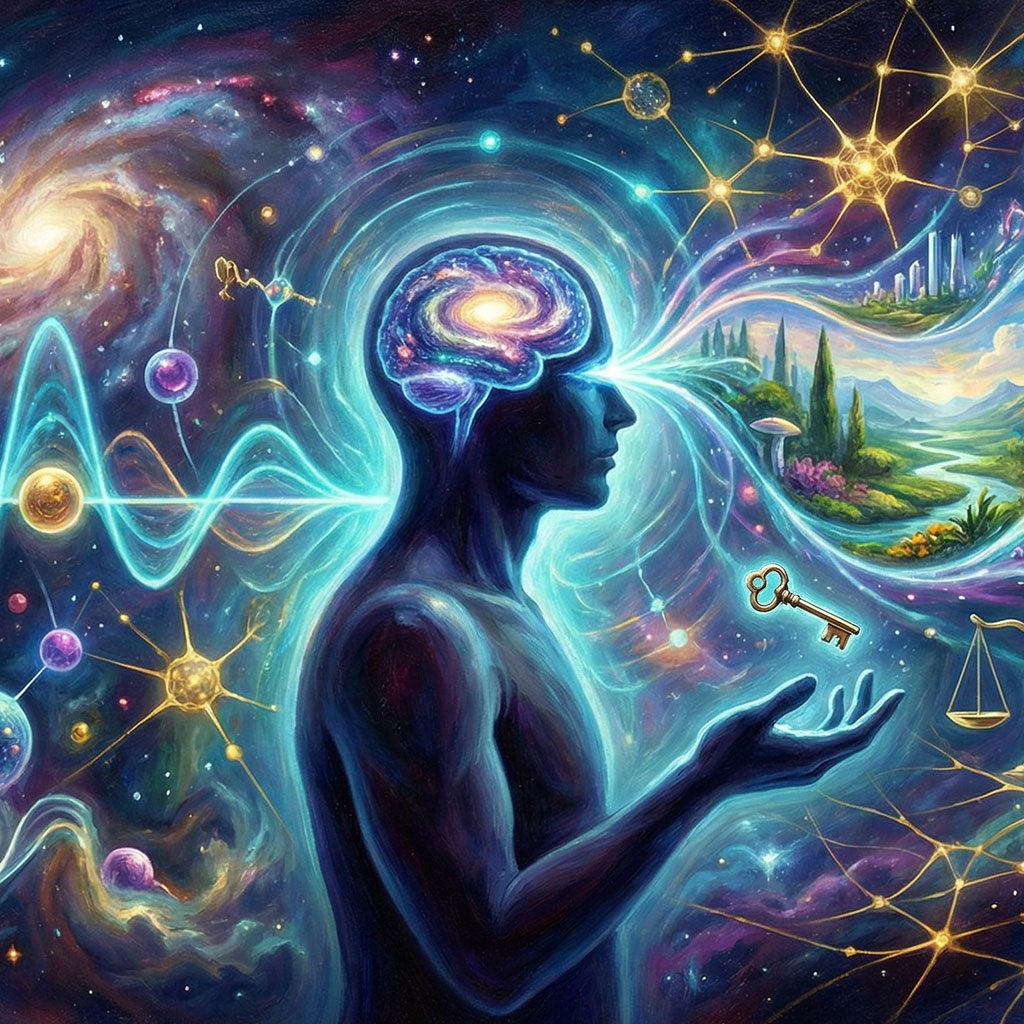
Quantum Mechanics and the Mind: Science, Metaphor, and the Creation of Reality
Does your mind influence matter? Discover the scientific truth and the powerful psychological metaphors behind the so-called 'Quantum Mysticism'.
The intersection of quantum mechanics, consciousness studies, and self-help literature has given rise to a cultural phenomenon known as 'Quantum Mysticism'. This complex relationship proposes that consciousness is not a mere biological epiphenomenon, but a fundamental substrate of the universe capable of influencing matter. From the roots of the New Thought movement to modern theories of reality manipulation, figures like Joseph Murphy, Vadim Zeland, and Joe Dispenza have sought to deconstruct the mechanism by which inner experience shapes objective reality.
Joseph Murphy’s Theology of the Subconscious
Dr. Joseph Murphy represents the bridge between 19th-century 'Religious Science' and modern self-help, introducing a binary view of the mind that foreshadows modern quantum concepts.
The Architecture of the Dual Mind
Murphy distinguishes between the Conscious Mind—the rational intellect acting as the 'watchman at the gate'—and the Subconscious Mind, the impersonal creative engine. The subconscious accepts every impression as an absolute truth and acts as fertile ground that sprouts any seed—thoughts of wealth or fear—planted in it by the conscious mind.
From Universal Mind to the Quantum Field
In Murphy’s vision, the individual subconscious is a portal to the 'Universal Mind'. Where Murphy spoke of 'divine transmission' and 'faith', modern commentators now read 'quantum entanglement'. His techniques, such as the 'Lullaby Method', aim to bypass the critical intellect to program the hologram of reality during the hypnagogic states of falling asleep.
Vadim Zeland: Transurfing and the Space of Variations
A cybernetic evolution of the Law of Attraction, Vadim Zeland’s Reality Transurfing adopts an algorithmic approach based on information theory and the multiverse.
The Space of Variations
Zeland postulates the existence of the 'Space of Variations', an infinite information field containing all possible pasts, presents, and futures. According to this model, we do not create reality, but rather choose which 'sector' or 'script' to illuminate by tuning our mental frequency to it, much like a spotlight illuminating a frame on a pre-existing film.
The Danger of Excess Importance
A key concept is 'Excess Importance': attributing too much value to a desire creates an energy tension that activates 'Balancing Forces'. These forces often prevent the goal from being reached to restore equilibrium. The solution lies in the 'pure intention to have', acting with the same naturalness as picking up the morning mail from the box.
Modern Synthesis: Joe Dispenza and the Quantum Field
Joe Dispenza attempts to demystify the miraculous by anchoring it in neuroplasticity and quantum biology, proposing a practical formula for personal change.
The Electromagnetic Signature
Dispenza argues that we interact with the Quantum Field through an electromagnetic signature: Clear Intention (the electrical signal of thought) combined with an Elevated Emotion like gratitude or love (the magnetic signal of the heart). By making these two signals coherent, the individual can theoretically 'collapse' events from quantum potential into physical reality.
The Void and Mental Rehearsal
To change one's life, one must enter 'The Void', a meditative state where you disconnect from your past identity to become 'no one'. Through 'mental rehearsal', the brain creates new neural connections as if the desired event has already happened, leveraging the brain's inability to distinguish between a real experience and a vividly imagined one.
The Verdict of Physics: Reality vs. Metaphor
It is essential to distinguish between the psychological validity of these systems and the rigor of orthodox quantum physics.
The Observer Effect and Decoherence
While quantum mysticism claims that human consciousness is solely responsible for the collapse of the wave function, standard physics explains that 'decoherence' occurs through any interaction with the environment (air, heat, light). The electron 'chooses' a state due to environmental entanglement, not necessarily because a human being is thinking about it.
The 'Hot, Wet, and Noisy' Challenge
The main scientific argument against a quantum brain is body temperature. Quantum states require extreme isolation and absolute cold; in the brain, quantum coherence decays in fractions of a second ($10^{-13}$ seconds)—a time far too short to influence the milliseconds required for neural thought processes.
Why It Works: Psychological Mechanisms
While the cited physics is often metaphorical, the successes reported by practitioners have real, documented neurobiological bases.
The Reticular Activating System (RAS)
Setting a 'clear intention' or visualizing a 'slide' programs the RAS filter in the brainstem. The brain begins to notice opportunities, resources, and patterns that were always present but previously filtered out as irrelevant. This creates the illusion that reality has changed, while only selective attention has shifted.
Placebo and Cognitive Reframing
Deep belief in healing triggers the release of neuropeptides and dopamine, activating the placebo effect. Simultaneously, Zeland's advice to 'reduce importance' is a cognitive reframing technique that lowers anxiety, allowing for better performance according to the Yerkes-Dodson psychological law.
A Modern Mythology for Human Agency
The 'Quantum Mechanics of the Mind' should be understood not as a literal description of particle physics, but as a phenomenology of human agency. Joseph Murphy provided a language for prayer, Vadim Zeland for cybernetic stoicism, and Joe Dispenza for neuroscientific meditation. By co-opting terms like entanglement and superposition, these systems provide a modern mythology that satisfies the human need for control in an uncertain universe, transforming the practitioner through the optimized mechanics of human psychology.
It is not magic that changes the world, but the mind's ability to tune into new possibilities through coherence and focused attention.